Table of Contents
- Introduction
- Levels of Knowing
- Climbing Knowledge Levels
- A Quick Literature Review
- Further Analysis and Considerations
- Conclusion
Introduction
As an immigrant teenager, I remember hearing “A.C.T.” mentioned in high school hallways and assuming it was some kind of extra credit thing. Rich American kid stuff. By the time I understood it was the test that determined college admission, I was registering for it at the end of my senior year. Unacceptably late. No one in my immediate world valued or had really done this before.

This pattern repeated throughout my life: graduate school, professional career, parenthood. The mysterious gap between not knowing and knowing fascinated me.
How does someone even get introduced to completely new knowledge, and to what degree can you claim you know it? There is always a blurry gray area between complete ignorance of something, to the comprehensive knowledge of it.
Let me ask you: what is it like to open up a business in Poland? Or how exactly do you become a brain surgeon in Nigeria. To what actual and practical actionable detail can you tell me and with what confidence?
If you have never done the thing, have never been the thing, or never have someone close to you repeatedly tell you about the thing, how would you really know about it? And how would you know it within the context of your own world view, abilities, and comfort?
Here I propose a framework for thinking about exactly that. Not just labeling levels of knowledge, but recognizing where you actually are while using that awareness to learn more effectively or help others do the same.
If you’re stuck on something, this might help you understand why. If you’re trying to teach or guide someone else, this might change your approach entirely.
NOTE
In this essay, knowledge is not just information. It includes the comfort and confidence of knowing or doing a thing. Sometimes the details are irrelevant. The feeling, confidence, and vision matter more. When I write knowing “a thing”, this could mean a concept, idea, belief, place, technique, and so on. I’m not talking about innate abilities like walking or breathing.
Levels of Knowing
Let’s start by outlining the extremes. On one side, you absolutely do not know a thing exists. It’s invisible and unimaginable (example: How do I register a car in Estonia?). On the other extreme, you know everything there is to know about it (example: How do I request a week off at the company I’ve worked at for 20 years?).
In reality, this spectrum is open-ended. You can definitely, completely not know something exists. But the detail, insight, and comfort you can gain from something already familiar is nearly infinite.
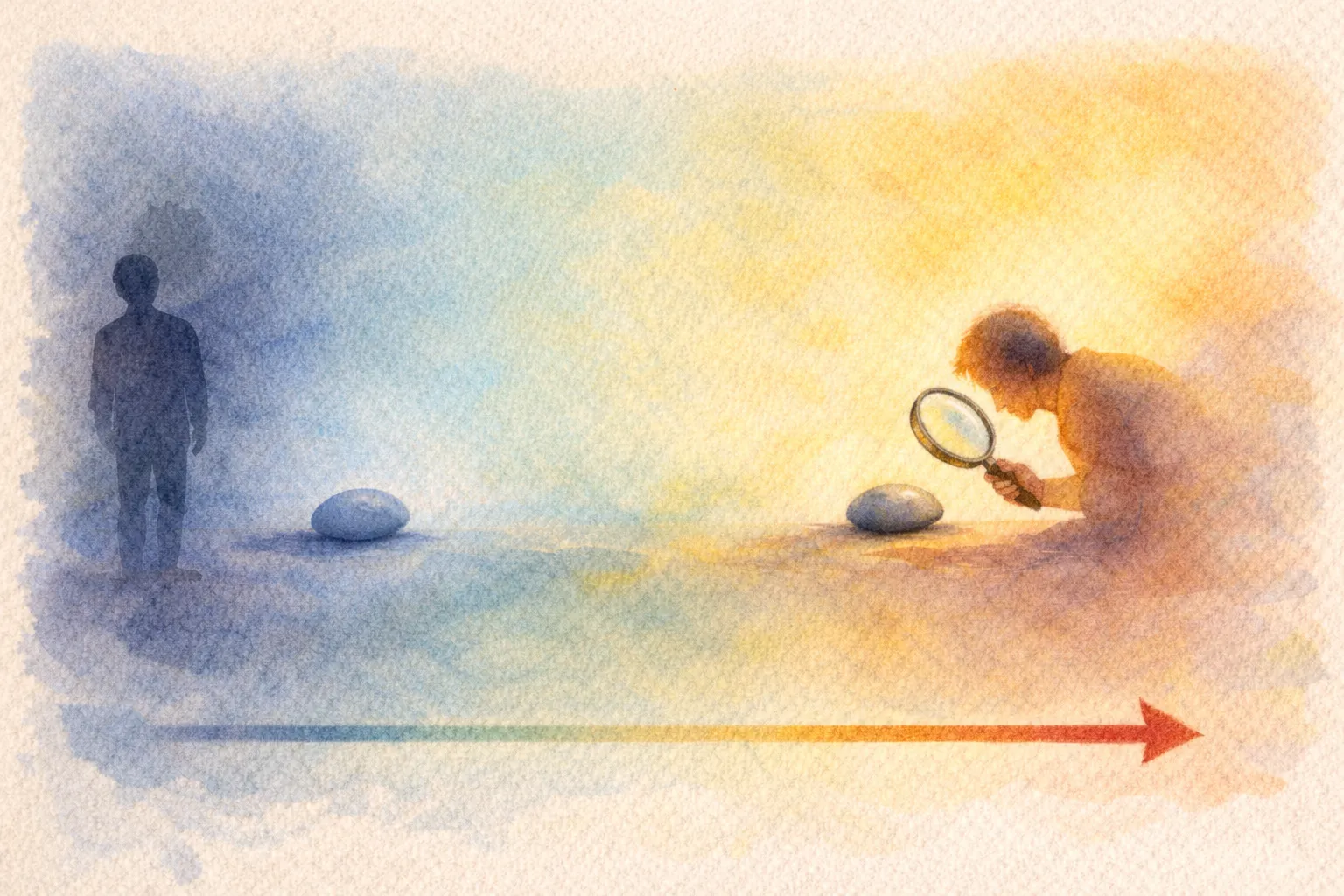
As an analogy, think about examining a physical object. At one extreme you look away completely, not seeing it. At the other, you examine it ever closer: different angles, a magnifying glass, a microscope. There’s always more to see.
Here I’m focused on describing practical, discrete levels along this spectrum. When I think about where our acquired knowledge and competence fundamentally comes from, I think there are very distinct levels of discovering and knowing something.
Let’s review these proposed levels:
Level 0: Invisible
You do not know the thing or anything about it. To you, it does not exist on any level. You cannot even have any comfort or emotional response toward it.
Example A: You don’t know people start businesses on the side. The concept of entrepreneurship outside a 9-5 job doesn’t exist in your world.
Example B: You’ve never heard of bow hunting. It’s not a concept that exists to you.
Level 1: Aware
You know about it or have heard of it. You have the info. You can google it or read about it. You do not know anyone personally that actually does the thing or is the thing. It generally seems out of reach.
Example A: You see a YouTube video about someone who built a six-figure Etsy shop on the side. Interesting, but seems like another world.
Example B: You read a magazine article of some celebrity bow hunting elk in South Africa. Fascinating, but feels completely foreign to your life.
Level 2: Adjacent
You know someone that knows/does/is the thing, but they are not close to you. You personally know that they really exist, but you do not really know how they think, make decisions, or their abilities. You cannot compare yourself directly to them.
Example A: Your coworker mentions her brother quit his job after his Amazon FBA business took off. You know it’s real, but you don’t know how he thinks or what it actually took.
Example B: A friend mentions his brother-in-law guides bow hunting trips in Colorado. You know someone who knows someone who does this.
Level 3: Embedded
The community you are part of naturally knows/does/is the thing. The community provides you with lots of direct or indirect examples and support. You are encouraged, supported, or rewarded to know the thing.
Example A: You join an entrepreneurship meetup group. Everyone is building something on the side. You hear about LLCs, profit margins, customer acquisition. It becomes normal conversation.
Example B: You join an archery club. People talk about hunting seasons, draw weights, broadheads. Bow hunting is normalized and encouraged.
Level 4: Intimate
You have someone very close to you that knows/does/is the thing. You know how this person thinks, makes decisions, or their abilities. You can compare yourself directly to them on many metrics. You can closely imagine what it is like to be like them on a day to day basis.
Example A: Your close friend launched a consulting business two years ago. You’ve seen the struggles, the wins, the late nights. You can compare yourself to them.
Example B: A close friend from the archery club has been bow hunting for years. You’ve seen his gear, heard his stories, watched him prepare for trips.
Level 5: Embodied
You yourself know/do/are the thing. You have first-hand and deep experience over time. You know what is and what is not possible.
Example 1: You’ve run your own side business for three years. You know the tax implications, the customer complaints, the thrill of a sale at 2 AM.
Example 2: You’ve bow hunted yourself. You know what 4 AM in the bush feels like, how to read tracks, when to draw.
Climbing Knowledge Levels
Observations and labeling of neat discrete levels are nice and all, however maybe more interestingly we can try to outline some ways someone might climb (or stumble) up knowledge levels.
The following is a non-exhaustive general list, however I am sure there may be more ways to do so. Also, this definitely is not an exact science or set law.
Luck, Chaos, Crisis
At the Invisible (L0) level, you have zero agency toward that specific knowledge. You cannot seek what you don’t know exists. You can’t google what you can’t conceive of. AI/LLMs can’t show you what you can’t ask, digest, or value. Nothing can come from nothing.
So how does anything break through from nothing? The environment acts upon you. This can look like an algorithm surfacing a video that shifts your worldview, a crisis that forces awareness (war, medical emergency, job loss), or simply overhearing a conversation at a coffee shop. The knowledge leaks into your awareness without anyone intending it.
Crisis creates awareness, not competence. Your agency is limited to widening your aperture. The specific breakthrough is largely out of your hands.
Primarily level transition from Invisible (L0) to Aware (L1), occasionally Invisible (L0) to Adjacent (L2) if crisis throws you directly into contact with practitioners.
Examples:
- A refugee learns about asylum law not by choice, but because displacement demanded it.
- A car accident introduces you to the world of physical therapy.
NOTE
Random food for thought: Creating chaos does not guarantee evolution and growth, but at least it gives us a chance.
Curiosity, Expanding Social Circles
Once you are Aware (L1) that a thing exists, you gain something powerful: the ability to seek. Curiosity is the engine. Not effort exactly, but pull. You follow a thread because it interests you. Curiosity separates them from those who climb.
Expanding social circles works similarly. You’re intentionally increasing your surface area for contact: networking, travel, online communities, talking to strangers. All of these increase the probability that someone who does the thing crosses your path.
Level transition from Aware (L1) to Adjacent (L2), sometimes Aware(L1) to Embedded(L3) if curiosity leads you to fully join a community. Many people stay Aware (L1) forever, passive but never seeking.
Examples:
- You read about woodworking online, then join a maker space to meet actual woodworkers.
- A podcast intrigues you, so you find the guest’s community and lurk in their forums.
Identity Shift, Institutions, Moving
Sometimes you don’t climb levels gradually, you teleport. Your identity changes, and knowledge that was Aware (L1) or Adjacent (L2) suddenly becomes Embedded (L3) because you are now part of that world.
Marriage into a family of doctors. Immigration. Joining the military. Converting to a religion. These are not just proximity changes. They are identity changes. The community’s knowledge becomes your community’s knowledge.
Institutions deserve special mention. Schools, apprenticeships, corporate onboarding. These are “level-climbing machines” that society has built. They manufacture proximity, structure effort, and build identities.
The knowledge isn’t deep yet, but access and community support are immediately present.
Level transition from Adjacent (L2) to Embedded (L3), but this mechanism can skip levels. You might jump from Aware (L1) to Embedded(L3) or even Invisible (L0) to Embedded (L3) if the shift is dramatic enough.
Examples:
- Marrying into a business family teaches you entrepreneurship at a visceral level.
- Immigrating, you suddenly must understand health insurance, credit scores, tipping.
- Military service immerses you in logistics and hierarchy whether you sought it or not.
Deepening Relationships, Mentorship
There is a difference between being among people who know the thing at Embedded (L3) and being close to someone who does. The Intimate (L4) level is about that closeness.
A mentor, close friend, family member. Someone whose thinking you can actually follow and relate to. You see how they make decisions, their doubts, failures, shortcuts. You can compare yourself to them because you know them as a full person, not just a role.
This is also where you can finally calibrate yourself: “If she struggled with this, I probably will too.” That comparative knowledge isn’t just information. It’s permission.
Level transitions from Embedded (L3) to Intimate (L4). Hard to skip because you can’t shortcut intimacy.
Examples:
- Your older sibling navigates college applications, and you watch every step.
- A senior colleague shows you how the unwritten rules actually work.
Effort, Necessity, Teaching
At some point, observation ends and action begins. The Embodied (L5) level is about doing the thing.
Effort is deliberate practice. Choosing to struggle through incompetence until competence emerges. Necessity is effort’s less glamorous cousin: the family business needs you, the project has no one else, the situation demands action. Teaching is the surprising one. Explaining a thing reveals every gap in your understanding.
Level transitions from Intimate (L4) to Embodied(L5) and deepening within Embodied (L5).
This transition typically is hard to skip. No amount of proximity or mentorship substitutes for firsthand experience. The final gap must be crossed by you, alone.
Examples:
- You finally rebuild the engine yourself after years of watching your father do it.
- Your company needs someone to manage the database, and you’re the closest thing they have.
- You teach a workshop and realize how much you were faking.
A Quick Literature Review
Without any kind of references to “real” and “serious” work, this may just be a shower thought, so let’s quickly dive into some similar concepts from the past. Thanks to cool modern AI/LLMs this was definitely more accessible.
Click below on each reference to view.
Outliers: The Story of Success (Malcolm Gladwell, 2008)
Gladwell’s central argument is that success is “grounded in a web of advantages and inheritances.” Timing, cultural heritage, family background, and access to opportunity matter as much as individual effort.
The famous “10,000 hours” concept requires access to practice opportunities, which is socially determined. Bill Gates had access to a computer at age 13 through his private school. You can’t practice what you don’t know exists.
Gladwell is fundamentally anti-individualist. Your social position determines which paths are even visible to you. However, he doesn’t provide a staged framework. It’s a collection of compelling case studies, not a systematic theory of how knowledge becomes visible.
Range: Why Generalists Triumph (David Epstein, 2019)
Epstein argues that broad “sampling” across domains and late specialization outperform early specialization in unpredictable environments. A sampling period allows people to discover interests and abilities before committing.
This is the popular literature that most directly addresses the Invisible (L0) problem. How do you discover what paths exist? Epstein shows that exploration reveals options you didn’t know existed. However, he focuses on individual exploration rather than social relationships as the discovery mechanism. In my framework, that discovery is almost always through people.
The Privileged Poor (Anthony Abraham Jack, 2019)
Harvard sociologist Jack distinguishes two types of low-income students at elite universities: the “Privileged Poor” (who attended elite prep schools on scholarship) and the “Doubly Disadvantaged” (from under-resourced public schools).
The Privileged Poor arrive culturally prepared. They learned the hidden rules earlier. The Doubly Disadvantaged face culture shock because they lack access to tacit knowledge about how elite institutions work.
This perfectly illustrates how social proximity determines what knowledge is even visible. The Doubly Disadvantaged didn’t know that office hours are for relationship-building, or that professors want you to approach them.
If no one in your world has done this, you don’t know what you don’t know. This is the Invisible (L0) problem in practice.
The Strength of Weak Ties (Mark Granovetter, 1973)
This landmark sociology paper argues that weak ties (casual acquaintances) are more valuable for accessing new information than strong ties. Your close friends largely know what you already know. Weak ties bridge different social circles, providing access to non-redundant information.
This directly supports the framework’s architecture. The weak tie is often the first bridge from “not knowing something exists” to “hearing about it.” That is the Invisible (L0) to Aware (L1) transition.
Granovetter focuses on information transmission rather than the full journey to Embodied (L5) expertise, but he provides the clearest theoretical support for why social proximity moves you out of ignorance.
Further Analysis and Considerations
As I’m putting this down on paper and organizing my thoughts I realize there are too many considerations to fully discuss here without overwhelming myself and the reader. Instead, here are some threads worth pulling on.
Click below on section to view.
On Modern Technology
- Social media and algorithms can push you from Invisible(L0) → Aware(L1) at scale, but do they create an illusion of being at higher levels than you actually are?
- AI and LLMs can surface information instantly, but does reduced effort mean reduced comfort and confidence with that knowledge?
- “Just google it” assumes the problem is access to information. But you can’t google what you can’t conceive of asking.
On Movement Between Levels
- Can you fall back in levels? What happens when your community shifts, or when you move away from the people who held that knowledge?
- Some people seem to specialize in certain transitions between specific levels. Others get stuck. Why?
- The effort to climb is probably non-linear. The Invisible(L0) → Aware(L1) gap may be the hardest to cross precisely because you have no agency there.
On Psychology And Perception
- Where does the Dunning-Kruger effect fit? Is it a mismatch between perceived level and actual level?
- There is potentially a difference between knowing something and being comfortable with it. You can have information without confidence, or confidence without information.
- Some things, like suffering and pain, can’t be directly communicated. But the reaction to them can. We watch how others respond and calibrate ourselves from there. “If that guy can suffer through it, why can’t I?” “If my parents are uncomfortable with it, it must be uncomfortable.”
On Truth
- The higher you climb, the better your approximation of truth and reality. The lower you are, the less resolution you have. At Invisible(L0), things aren’t even blurry. They simply don’t exist.
Conclusion
Looking back at that panicked late-night ACT registration, I can now trace exactly what happened. The knowledge moved from Invisible (L0) to Aware (L1) through some combination of luck and overheard conversation. But it stayed at Aware (L1) for too long because I had no one at Adjacent (L2) or above. No friend’s cousin who had done it. No community where college prep was normal. No parent to guide me through application essays. By the time I understood what I was dealing with, I was already behind.
This framework won’t really solve that problem. But maybe it helps name it.
If you are trying to learn something new, ask yourself: what level am I actually at? Do I just know about it, or do I know someone who does it? Is my or any community supportive of this, or am I going it alone? Do I have someone close enough to calibrate against?
And if you’re trying to help someone else learn, ask: what level are they at? Giving information to someone at Invisible (L0) is useless. They need proximity first. They need to see that people like them can do this thing.
The paths we can see are shaped by the people around us. That’s not a limitation to overcome. It’s just how knowing works.

If you have actually entirely read this post, very cool! Thanks for reading my attempt to structure a “shower thought” that I have been meaning to organize and get my head around. It obviously is not perfect as first iterations rarely are. I would love to hear your thoughts, so please contact me any way you feel appropriate.
No spam. Unsubscribe any time.